US reciprocal Tariff – a liberation or igniting recession
US President Donald Trump, on 2nd April 2025, released a list of Tariff imposed on goods imported by US. He called the April 2 as “Liberation Day” and promised economic benefits from his tariff policies. However , the tariff are much more than anticipated or can be handled by economies, it may also trigger a trade war globally while also putting pressure on people. Bernd Lange, chair of the European Parliament’s International Trade Committee, says it would better be called “Inflation Day” than Liberation day.
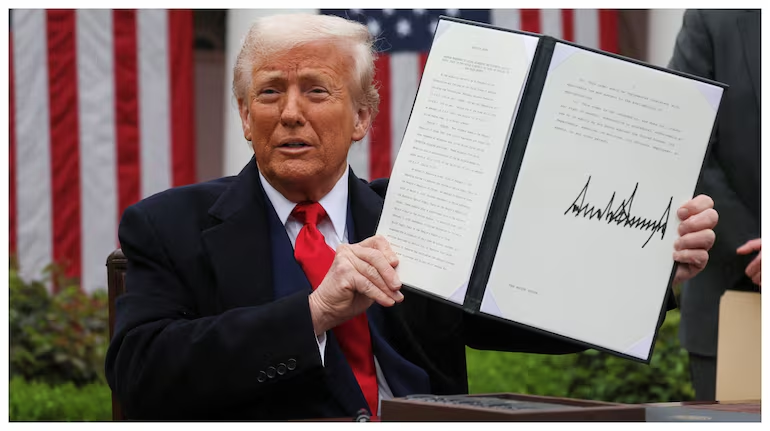
US President Mr Donald Trump announces the Tariff on 2nd April US time.
What is Tariff
Tariff are taxes imposed on good which are not manufactured in country and are rather imported. So the Companies bringing the goods into the country pay the amount, typically a percentage of the goods’ value, to the government.
What Tariff Matters and its direct impact
Why is Trump keen on Tariffs
Trump is a businessman before becoming the US president , and has a bachelor’s degree in Economic. He strongly argued since 1980 on how US economy can be boosted through taxes. Trump also believes that such tariffs do “gives great power to negotiate’. During his previous presidency (2017-2021), Donald Trump implemented a series of tariff policies aimed at protecting American industries, reducing the trade deficit, and pressuring trading partners into negotiating more favorable agreements. While the results will be clear in future, it seems the tariff is like an double edge sword to him which could boost economy by promoting manufacturing within states & tax inflows and on the other side it give power to have favourable negotiations and gain benefit. widely held view that Trump is launching an opening gambit in what will be one-on-one discussions with individual countries that will ultimately see the new U.S. tariffs sharply reduced.
Section 4 B has penalties for retaliation while section 4C permits reduction of tariffs on economic and national security matters.
Section 4C of Trump’s executive order stated, “Should any trading partner take significant steps to remedy non-reciprocal trade arrangements and align sufficiently with the United States on economic and national security matters, I may further modify the HTSUS to decrease or limit in scope the duties imposed under this order.”
How much is the Tariffs imposed
Trump imposed the highest U.S. import taxes in a century through the newly announced reciprocal tariffs set a 10% baseline duty on imports, with steeper levies on key trade partners – China (54%), the EU (20%), Japan (24%), Thailand (36%), Indonesia (32%), Vietnam (46%) and India (26%). Interestingly, tariffs levied on India are the lowest amongst its Asian peers.
* Energy and base metals were left out of immediate tariff hikes
How is Tariff Calculated
Asked about its methodology, White House Deputy Press Secretary Kush Desai posted on X that “we literally calculated tariff and non-tariff barriers” and included a screenshot of a White House paper setting out the algebra behind the formula.
Asked on CNBC how the Trump administration came up with the formula, Commerce Secretary Howard Lutnick did not directly explain it but said United States Trade Representative (USTR) economists had worked for years on a metric that reflected all trade barriers set up by a given country.
But by a close observation by economists, appears the Trump administration used a simple formula to calculate the tariffs: It took each country’s trade deficit (difference between value of export and import from a country) with the US, divide it by the value of that country’s exports to the US – and then divided this figure by half, in a gesture of “kindness.”
Formula – take the U.S. goods trade deficit with a country, divide it by that country’s exports to the U.S. and turn it into a percentage figure; then cut that figure in half to produce the U.S. “reciprocal” tariff, with a floor of 10%.
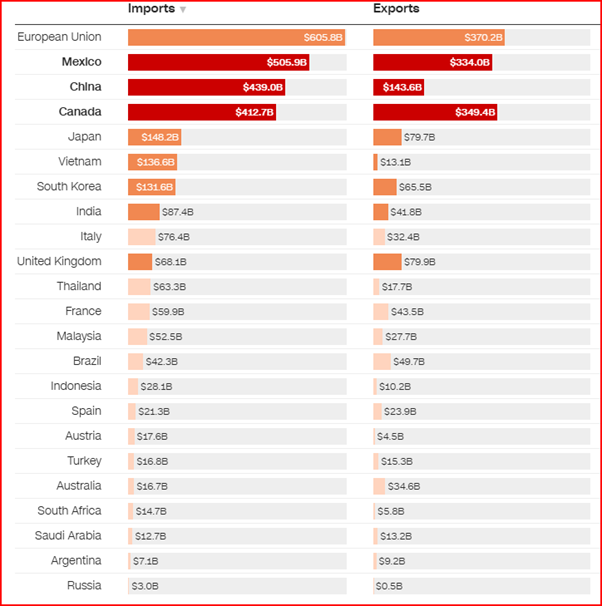
Example : Vietnam bought just $13.1 billion of goods from the US that same year. in 2024 while selling $136.6 billion worth of goods to the US. So here Vietnam has a trade surplus of $123.5 billion with the US by subtracting $13.1 billion from $136.6 billion, Dividing the $123.5 billion by $136.6 billion (the value of Vietnam’s exports to the US) gives 0.90 – or, in percentage terms, 92%. And this divided by 2 gives 46% , which is what is tariff applied for Vietnam. U.S. has a $235.6 billion trade deficit with the European Union, which exports a total of $605.8 billion to the U.S. Based on the White House’s formula, $235.6 divided by $605.8 equals 0.388, which divided by half is 0.194. That number gets rounded up to 0.2, which leads to a 20% tariff rate.
The bluntness of the formula is applied to economies which cannot afford to import much from the U.S. inevitably leads to a high reciprocal tally: 50% for Lesotho in Southern Africa, 49% for Cambodia in Southeast Asia. Consider case of Madagascar, one of the poorest nations in the world with gross domestic product (GDP) per head of just over $500, faces a big 47% tariff due to the modest $733 million of exports of vanilla, metals and apparel that it did with the U.S. last year.
But the formula is also sowing confusion among rich countries. For the European Union it has produced a punitive tariff of 20% – four times the 5% which the World Trade Organization calculates as the EU’s average tariff rate.
Reaction
The Markets around the globe showed lot of losses specially China, but even US market have not reacted positively to Trump’s announcement of tariffs. The S&P 500/ Dow jones fell more than 4% and he NASDAQ composite dropped 5.3%, next day post tariff announce. The stock market rout was rather expected, given that most economists considered the U.S.’s entry into a global trade war to be bad for the economy. However, the reality of the situation hit investors hard.
The shock of President Trump’s sweeping tariffs reached even to Energy and Base metals, which witnessed a sharp decline, even though it was in exclusion list of tariffs. Copper fell to multi-week lows on the LME and Comex, driven by concerns that higher tariffs would slow global growth and industrial demand. Aluminum prices also hit a six-month low as trade tensions escalated. This price fall was due to uncertainty, expecting drop in demand and escalating trade tensions and economic disruptions, so these prices may remain volatile in near future.
Leaders around the world are responding to US President Donald Trump’s announcement of tariffs on virtually every country.
These are the latest countries to respond:
- China : China has Criticized the tariffs as harmful and promised “resolute countermeasures”, which are likely to hurt US companies trying to sell into the huge Chinese market
- European Union: Targeted American whiskey, motorcycles, and agricultural goods with counter-tariffs. EU Warned of significant economic fallout and is preparing retaliatory measures.
- Germany: Outgoing German Chancellor Olaf Scholz said the tariffs are “fundamentally wrong” and will cause harm across the globe and to America itself. “We want cooperation, not confrontation, and will defend our interests”
- United Kingdom: Keir Starmer said Britain would respond to the tariffs with “cool and calm heads,” but the UK prime minister added that “clearly, there will be an economic impact.” Starmer told business leaders in Downing Street that Trump “acted for his country, and that is his mandate. Today, I will act in Britain’s interests with mine.”
- France: The French government attacked the “imperialist posture” of Donald Trump, whom a spokesperson accused of wanting to be “master of the world,” in a rare personal attack Thursday on the US president following his announcement of global tariffs.
- Belgium: “By playing with matches, the United States will end up getting burned” the Belgian Deputy Prime Minister Maxime Prévot said. He added that it is “regrettable” that the US has “decided to unilaterally attack the global trade order by applying tariffs to everyone and especially to its partners.”
- Italy: Prime Minister Giorgia Meloni cleared her schedule for Thursday to focus on the fallout from the punishing tariffs.
- Norway: Tariffs on both America’s allies and adversaries could violate an article in the NATO treaty that orders the alliance’s members to promote economic stability and collaboration, Norway’s foreign minister said Thursday. Espen Barth Eide told reporters while arriving at the NATO headquarters in Brussels that allies would do well to remember this “important part of the treaty.”
- Canada & Mexico: Initially hit by steel tariffs but later reached agreements under the USMCA (United States-Mexico-Canada Agreement). Prime Minister Mark Carney vowed countermeasures to protect.
- South Africa: The government labeled the tariffs imposed on the country by Trump as “punitive” but said it wants to negotiate a new trade deal urgently. “The tariffs affirm the urgency to negotiate a new bilateral and mutually beneficial trade agreement with the US, as an essential step to secure long-term trade certainty,” the South African government said in a statement.
- Japan: Described the decision as “extremely regrettable” and is seeking exemptions.